Key takeaways
- Theme and mechanics answer different buying questions.
- Shared mechanics are clues, not guarantees of identical experiences.
- Use a favorite game as a reference, then read a sample turn.
Theme attracts attention; decisions sustain interest
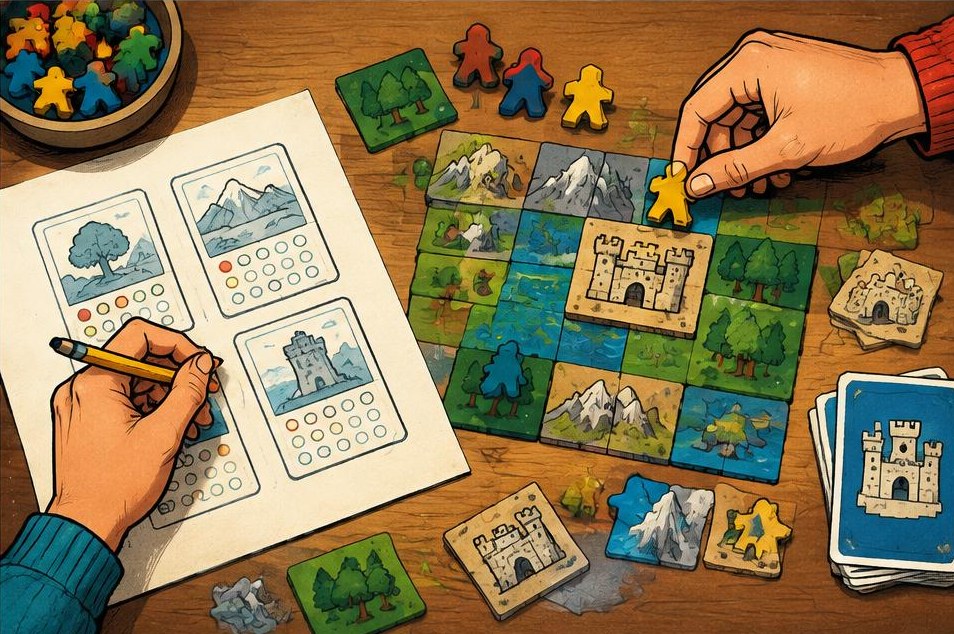
Birds, castles and space exploration can all make an appealing cover. But the same theme can support very different activities: selecting cards, managing resources, telling stories or negotiating trades. If you love the artwork but dislike the decisions, the theme alone may not bring the game back to the table.
Mechanics are useful vocabulary for those decisions. They help you explain why you like a game beyond saying it is fun. Do you enjoy planning an engine, interpreting clues, reading opponents or arranging a satisfying pattern? Start with that specific pleasure rather than collecting every game carrying the same label.
A plain-language guide to common mechanics
The following descriptions are introductory summaries. Individual games often combine several mechanisms and change how they work. Read the rulebook's actual sequence of play before deciding that a familiar label means a familiar experience.
| Mechanic | Plain-language idea | Question to ask |
|---|---|---|
| Card drafting | Choose cards from a selection | Do I enjoy weighing what to keep and pass? |
| Deck-building | Add cards to a deck during play | Do I enjoy shaping future turns? |
| Worker placement | Assign pieces to action spaces | Do I enjoy competition for limited actions? |
| Tile placement | Arrange pieces on a shared or personal area | Do I enjoy spatial puzzles? |
| Cooperative play | Pursue a shared outcome | Do I want group discussion and shared stakes? |
Your favorites are a good place to start
Let the games you love inspire the next one on your shelf.
My gamesSee a mechanic in a concrete example
Sushi Go! illustrates pick-and-pass drafting. Its official rules describe players simultaneously choosing a card, revealing it and passing the remaining hand to the left. The publisher explains that players collect combinations of sushi dishes to score points. That sequence is more informative than the label ‘card game.’
Notice the buying questions it raises. Do you like choosing between several tempting options? Are you comfortable learning combinations and scoring symbols? Will passing cards be easy at your table? The official specifications—2–5 players, ages 8+ and around 15 minutes—answer some practical questions, but not all the preference questions.
Do not let labels become a trap
Two worker-placement games can differ dramatically in rulebook size, interaction and playing time. A familiar mechanic may make the first explanation easier to follow, but it does not promise a familiar experience. Complexity, scoring structure and the number of available actions still deserve attention.
Look for both resemblance and contrast. If your collection already contains several games serving the same mood and group size, a new purchase might be more useful when it adds a different experience. If your favorite is reliably requested, a close alternative might be exactly what your group wants. Decide which problem the new game solves.
Describe your taste with examples
Rank games you own by how much you want to play them, then write one sentence about your top choices. ‘I like watching my deck improve’ or ‘I enjoy a shared puzzle without direct attacks’ gives you a better buying brief than a star score alone.
Meeple Matters uses your ranked owned games to look for overlapping mechanics, themes, designers and complexity. That is a preference clue, not proof that two games play alike. Use it to discover candidates, then check their rules and practical fit before adding one to your consideration list.
Frequently asked questions
Are deck-building and card drafting the same?
No. Drafting describes selecting from available cards; deck-building describes changing your playing deck during a game. A game can use both.
Should I only buy games with mechanics I already like?
Not necessarily. Familiar mechanics reduce uncertainty, but a different experience may fill a useful gap. Try a demo, borrowed copy or rules explanation first.
Sources & further reading
Source notes identify the facts each reference supports. Buying frameworks, schedules and price examples are editorial guidance, not research findings or current offers.
- Gamewright: Sushi Go!
Publisher specifications: ages 8+, 2–5 players, approximately 15 minutes; card drafting.
- Sushi Go! official rules
Primary reference for the example's choose, reveal and pass sequence.
- Community source: Weight
Primary reference for the 1–5 community complexity scale and its limitations.
About this guide
Published by Meeple Matters, a board game discovery site. These AI-assisted guides synthesize publisher specifications, community scoring documentation and practical buying considerations. They are not hands-on reviews, original research or claims of professional testing. No individual reviewer credentials are implied.
Our current discovery catalog is limited, and store prices and Amazon ratings are estimates until verified data sources are connected. Check current specifications, stock and prices with the publisher and retailer. As an Amazon Associate, Meeple Matters earns from qualifying purchases through its shopping links.
Your favorites are a good place to start
Let the games you love inspire the next one on your shelf.
My games