Key takeaways
- Average user rating and Adjusted Rating are not the same number.
- Weight is subjective and can reflect both rules and strategic depth.
- Small numerical differences should not override practical fit.
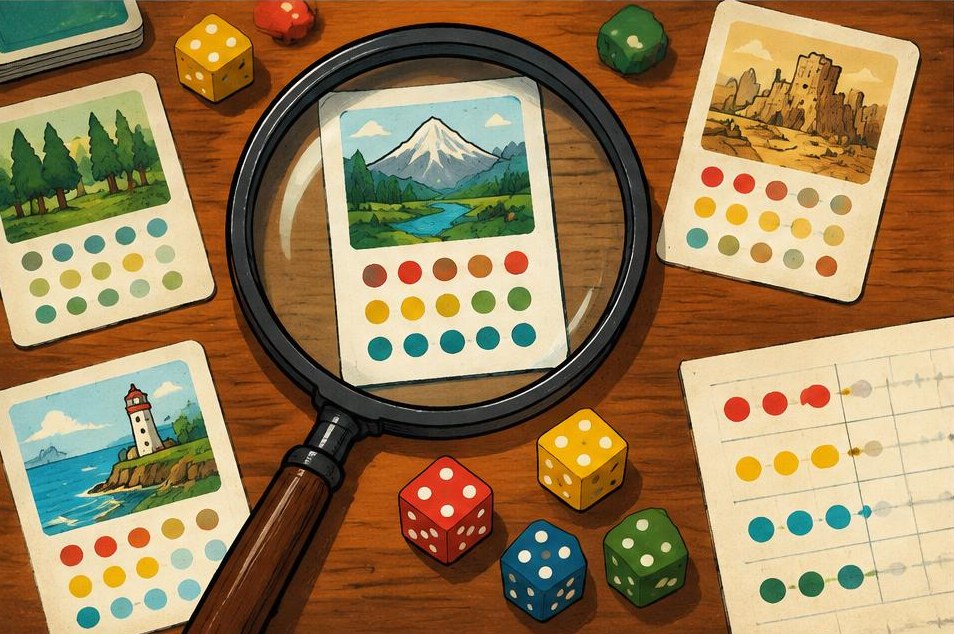
A user rating is an opinion about wanting to play
The community suggested user-rating scale runs from 1 to 10. Its descriptions emphasize enthusiasm and willingness to play: an 8 is described as a very good game the user likes to play, while a 7 is a good game they are usually willing to play. That makes the number useful, but not an objective laboratory measurement.
An average combines those subjective votes. It does not tell you that your particular group will prefer an 8.1 game to a 7.8 game, and it is not an 81% probability of enjoyment. Read comments from players with similar tastes and experience levels, especially when deciding between two otherwise plausible purchases.
Average Rating and Adjusted Rating are different
The community rankings documentation distinguishes the simple Average Rating from the adjusted Adjusted Rating used in rankings. It describes Bayesian averaging and protections against manipulative voting. Do not assume a rank is just a list sorted by the unadjusted average.
For a buying decision, the important lesson is restraint: rank can lead you to games worth investigating, but it is not a substitute for knowing your player count, available time and appetite for rules. A celebrated game that stays in the cupboard is not necessarily a better purchase than a modestly rated favorite you play every week.
| Signal | Useful for | Does not establish |
|---|---|---|
| Average Rating | Community enthusiasm | Your personal enjoyment |
| Adjusted Rating / rank | Adjusted ranking context | A perfect game for every household |
| Weight | Approximate complexity comparison | Exact teaching or playing time |
Find your next table favorite
Good company. The right game. A night worth repeating.
Find a gameRead weight as a conversation starter
The source labels its five weight points Light, Medium Light, Medium, Medium Heavy and Heavy. Its wiki explicitly says weight is not clearly defined. Different voters may be thinking about learning the rulebook, the depth of planning, technical skill or how many plays it takes to understand the game.
A high weight does not automatically mean a long playtime, and a low weight does not mean shallow choices. Compare a candidate with a game you know. ‘Is this roughly as demanding as our current favorite?’ is a more grounded question than ‘Is 2.6 too hard?’ Avoid treating any decimal as a rigid age recommendation.
Use the signals without surrendering your judgment
Set a broad rating preference, choose a complexity range based on games your group enjoys, and inspect the shortlist. If the list is too narrow, relax a preference rather than accepting a game that cannot accommodate your table.
Meeple Matters weights the factors you place higher more strongly and gives some credit to near misses. Its current starter catalog contains hand-entered values; community ratings are snapshots rather than live scores. Check source documentation for any finalist rather than assuming every displayed figure has just been refreshed.
Frequently asked questions
Is community weight the same as game quality?
No. It reflects community views about complexity. A light game can be excellent, and a heavy game can be the wrong fit.
Does an 8/10 average mean an 80% chance I will enjoy a game?
No. An average rating combines subjective user scores. It is not a probability model for your group.
Sources & further reading
Source notes identify the facts each reference supports. Buying frameworks, schedules and price examples are editorial guidance, not research findings or current offers.
- Community source: Ratings
Primary reference for subjective user ratings and the average rating.
- Community source: Weight
Primary reference for the 1–5 community complexity scale and its limitations.
- Community source: More About Rankings
The community explanation of Average Rating versus Bayesian-adjusted Adjusted Rating.
About this guide
Published by Meeple Matters, a board game discovery site. These AI-assisted guides synthesize publisher specifications, community scoring documentation and practical buying considerations. They are not hands-on reviews, original research or claims of professional testing. No individual reviewer credentials are implied.
Our current discovery catalog is limited, and store prices and Amazon ratings are estimates until verified data sources are connected. Check current specifications, stock and prices with the publisher and retailer. As an Amazon Associate, Meeple Matters earns from qualifying purchases through its shopping links.
Find your next table favorite
Good company. The right game. A night worth repeating.
Find a game