Key takeaways
- Use one consistent question when comparing games.
- A favorite-first order reveals preferences, not objective quality.
- Look for both shared pleasures and gaps in your collection.
Why an order can be more useful than another star score
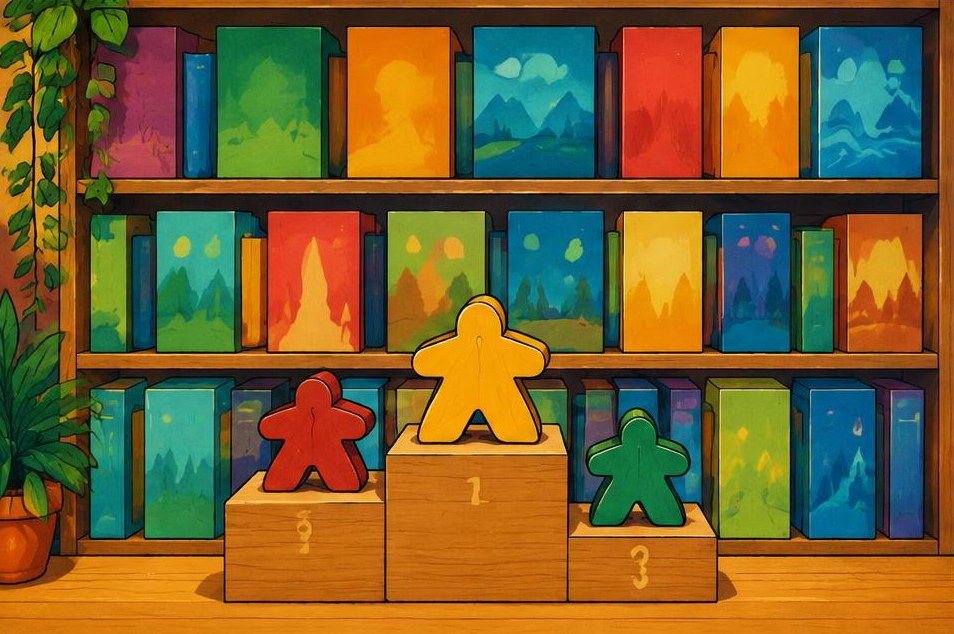
You may genuinely like ten games and still struggle to decide which one deserves four stars instead of five. Relative choices can be easier: ‘If both were ready on the table, which would I choose tonight?’ Repeating that comparison produces a personal order that has meaning for your own buying decisions.
The order is not a public verdict about quality. A game can sit lower because it needs six players you rarely have, even if you admire its design. Keep your comparison question consistent so the list does not quietly alternate between favorite artwork, best memories and most frequent play.
Place each game between two neighbors
Start with two owned games and choose the one you would rather play. Add a third above, below or between them. For a larger collection, compare a new game around the middle, then narrow its position until you find plausible neighbors. You do not need to compare it against every title from scratch.
Allow yourself to revise. A new session can change your opinion, and your usual group can change too. The useful outcome is a list that reflects current preference, not an irreversible judgment made after one exceptional evening.
| Current order | Your comparison | New position |
|---|---|---|
| A, B, C | Prefer A over the new game | Below A |
| A, B, C | Prefer the new game over B | Above B |
| Final order | A, new game, B, C | Between A and B |
Your favorites are a good place to start
Let the games you love inspire the next one on your shelf.
My gamesLook for patterns, then test them
Review your top few games and identify the decisions you enjoy: building combinations, arranging tiles, negotiating or solving a shared problem. Also note complexity, theme and the group size you actually use. A recurring pattern gives a recommendation somewhere sensible to start.
Do not overinterpret a single favorite. If it is the only cooperative game you own, you cannot yet know whether you love cooperation generally or that game's particular theme and pace. Similarity should produce candidates to investigate, not a claim that an algorithm has discovered your complete personality.
Find a useful gap rather than a duplicate
A new game can earn its place by doing something your collection cannot: accommodating a different group size, fitting a shorter evening or offering a different interaction style. It can also earn its place as an alternative to a beloved experience. Both are valid if you know which purpose you are buying for.
Use a consideration list to separate discovery from checkout. Compare shortlisted games by rating, complexity, time and price, but keep notes about who would play. A spreadsheet full of strong numbers cannot tell you whether your friends want another long campaign.
Use the list in Meeple Matters
The My games page lets you place and reorder games you own. The app uses higher-ranked entries more strongly when comparing mechanics, themes, designers and complexity. The resulting fit score is a signal of resemblance, not a promise of enjoyment or a psychological assessment.
Games saved for consideration have a separate sortable page and can be exported. Your collection, preferences and saved searches are stored on this device rather than synchronized to an account, so use the same browser and export important shortlists if you need a separate copy.
Frequently asked questions
What should I do when two games feel tied?
Put them next to each other and choose an approximate order. Revisit after another play; the purpose is useful guidance, not mathematical certainty.
Will ranking my collection guarantee better recommendations?
No. It supplies more personal context, but recommendations still depend on catalog coverage, available game data and practical constraints.
Sources & further reading
Source notes identify the facts each reference supports. Buying frameworks, schedules and price examples are editorial guidance, not research findings or current offers.
- Community source: Ratings
Primary reference for subjective user ratings and the average rating.
- Community source: Weight
Primary reference for the 1–5 community complexity scale and its limitations.
About this guide
Published by Meeple Matters, a board game discovery site. These AI-assisted guides synthesize publisher specifications, community scoring documentation and practical buying considerations. They are not hands-on reviews, original research or claims of professional testing. No individual reviewer credentials are implied.
Our current discovery catalog is limited, and store prices and Amazon ratings are estimates until verified data sources are connected. Check current specifications, stock and prices with the publisher and retailer. As an Amazon Associate, Meeple Matters earns from qualifying purchases through its shopping links.
Your favorites are a good place to start
Let the games you love inspire the next one on your shelf.
My games