Key takeaways
- Wingspan’s base game lists 1–5 players and 40–70 minutes.
- Cascadia’s base game lists 1–4 players and 45 minutes.
- Choose between card-driven combinations and spatial wildlife scoring, not birds versus bears alone.
Two nature games with different centers of attention
Stonemaier describes Wingspan as a competitive, medium-weight, card-driven engine-building game. Birds extend chains of combinations in your habitats, and actions help you gain food, lay eggs and draw or play cards. The buying question is whether you want to spend the evening learning how those abilities connect.
AEG describes Cascadia as a tile-laying game in which you choose a tile and token set, then build habitats and arrange wildlife. You score habitat corridors and animal goals. Its decisions center on where things go and which pattern to develop, rather than the text of a growing collection of individual bird abilities.
| Game | Players | Listed time | Main focus |
|---|---|---|---|
| Wingspan | 1–5 | 40–70 minutes | Bird cards and action combinations |
| Cascadia | 1–4 | 45 minutes | Habitat corridors and wildlife patterns |
Reading versus spatial planning
If your group likes discovering a useful card and making future turns stronger, Wingspan is the more relevant starting point. Inspect several real cards and a rule explanation before deciding how much reading everyone can comfortably manage. A theme someone loves does not remove the need to understand the abilities in front of them.
If the group prefers visible geometric choices, Cascadia may be a better first investigation. Explain the wildlife scoring cards before drafting so that players understand what their arrangements are trying to achieve. Less emphasis on individual card abilities does not mean no learning: multiple scoring goals still require attention.
Find your next table favorite
Good company. The right game. A night worth repeating.
Find a gameYour head count can settle the shortlist
For five players, Wingspan’s base-game range fits while Cascadia’s base-game maximum does not. Cascadia: Landmarks extends the range according to AEG, but an expansion is a separate purchase with additional material. Do not compare an expanded player count against a base-game price.
Both publishers support solo play in the base game. If solo is the main reason to buy, read the solo rules separately rather than assuming the multiplayer description answers that question. You may value a different challenge structure when there is no shared draft against other people.
Buy the right nature-game experience
Choose Wingspan for evolving combinations and Cascadia for spatial pattern satisfaction. These are mechanism-based fit recommendations, not claims from hands-on testing. Either can be the wrong purchase if the real evening calls for fast conversation or a shared cooperative objective instead.
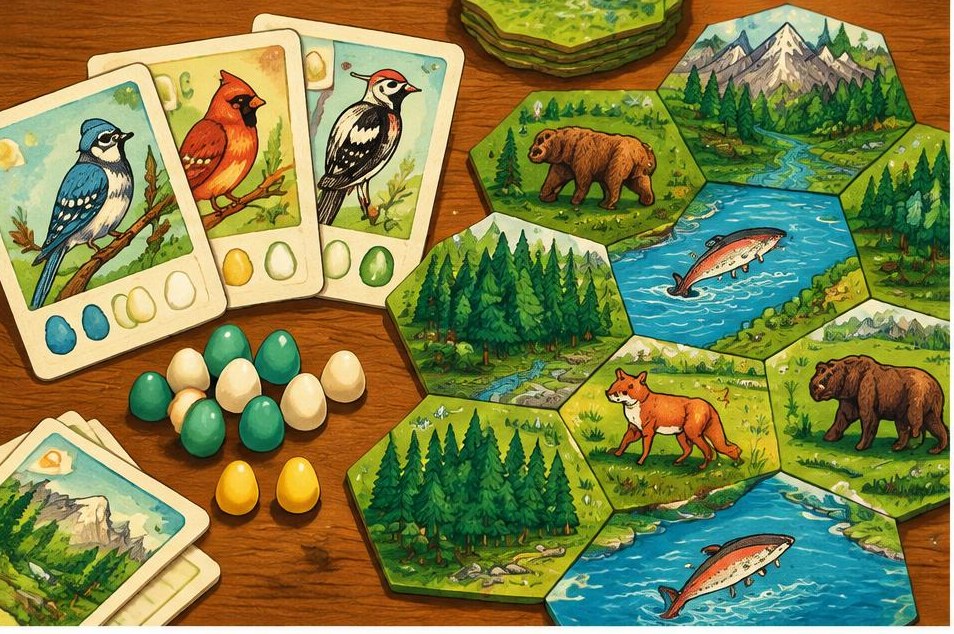
Check that a retailer result is the intended base game. Wingspan expansions and other Cascadia titles can appear in the same search. Compare condition, language and delivered cost; do not treat the illustrated scene above as a photograph of included components.
Compare the games
As an Amazon Associate, Meeple Matters earns from qualifying purchases. These links open retailer searches; confirm the exact base game, edition, seller and delivered price.
Wingspan
A card-driven engine for players who enjoy building combinations.
Cascadia
A spatial habitat puzzle with wildlife patterns and variable goals.
Frequently asked questions
Is Cascadia a cooperative game?
The standard multiplayer base game is competitive: players build their own scoring habitats.
Which base game supports five players?
Wingspan lists up to five. Cascadia’s base game lists up to four.
Are they similar because they feature wildlife?
The theme overlaps, but Wingspan emphasizes card-driven engines and Cascadia emphasizes spatial habitat and wildlife arrangements.
Sources & further reading
Source notes identify the facts each reference supports. Buying frameworks, schedules and price examples are editorial guidance, not research findings or current offers.
- Stonemaier Games: Wingspan
Base game: 1–5 players, 40–70 minutes; competitive card-driven engine building.
- AEG: Cascadia
Base game: 1–4 players, ages 10+, 45 minutes; habitat corridors and wildlife scoring.
About this guide
Published by Meeple Matters, a board game discovery site. These AI-assisted guides synthesize publisher specifications, community scoring documentation and practical buying considerations. They are not hands-on reviews, original research or claims of professional testing. No individual reviewer credentials are implied.
Our current discovery catalog is limited, and store prices and Amazon ratings are estimates until verified data sources are connected. Check current specifications, stock and prices with the publisher and retailer. As an Amazon Associate, Meeple Matters earns from qualifying purchases through its shopping links.
Find your next table favorite
Good company. The right game. A night worth repeating.
Find a game