Key takeaways
- Sushi Go! lists 2–5 players and 15 minutes; Party lists 2–8 and 30 minutes.
- Both list ages 8+, but new scoring combinations still need explaining.
- Buy for your usual head count rather than the biggest party you might host.
The difference that matters first: your head count
Gamewright lists the original Sushi Go! for two to five players, ages eight and up, with an approximately fifteen-minute playing time. Sushi Go Party! lists two to eight players, the same age recommendation, and approximately thirty minutes. These are publisher estimates, not a promise about your first teach. If six people reliably join, the original is not the right base box for that group.
For a household that normally plays with three or four people, the extra seats do not settle the decision. The meaningful question becomes whether you want a familiar menu every time or enough combinations to change what you are drafting. More content is useful when you actually want to select and teach it.
| Box | Players | Listed time | Main distinction |
|---|---|---|---|
| Sushi Go! | 2–5 | 15 minutes | Fixed card menu |
| Sushi Go Party! | 2–8 | 30 minutes | Customizable menu |
A fixed menu can be an advantage
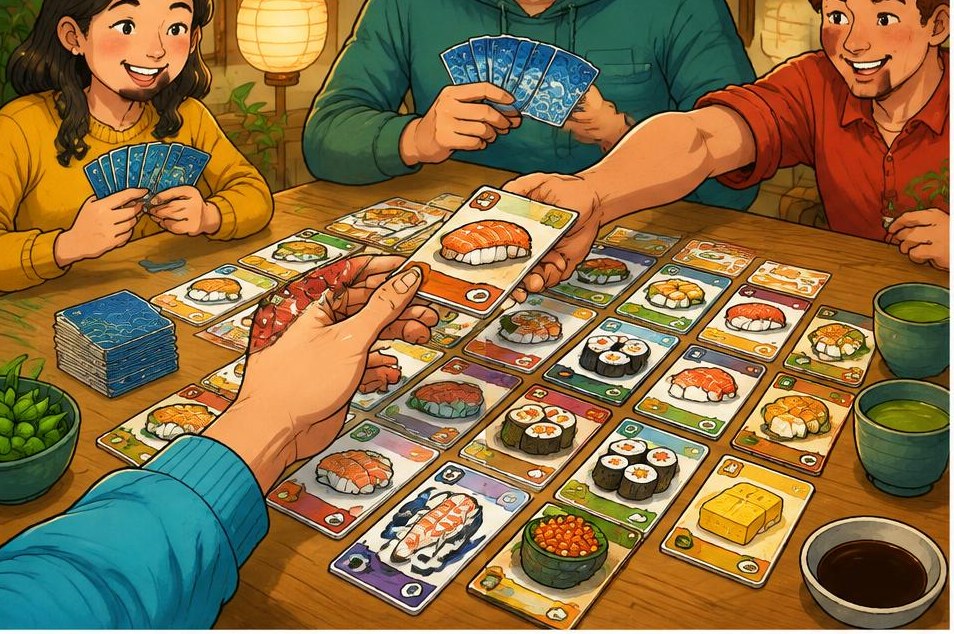
Both games center on choosing cards and passing the rest of your hand. The original provides a consistent set of scoring combinations. Repeated play can therefore focus on recognizing what is available and anticipating what will come back, rather than explaining a fresh scoring menu. That consistency can suit a family learning drafting for the first time.
Party lets you build a menu from more than twenty dish types according to its publisher. That changes which combinations compete for attention. It is the more flexible purchase when you enjoy varying a familiar framework, but the menu selection and explanation are part of the evening rather than free variety.
Find your next table favorite
Good company. The right game. A night worth repeating.
Find a gamePortability and setup are different buying questions
The original centers on its card deck; Party adds a board, menu tiles and wooden pawns alongside a larger card collection. Read the component lists when planning to play on a train tray or crowded café table. A physically compact container is not the same as a compact playing area once hands, discarded cards and scoring components are spread out.
For travel, choose the version you can set up comfortably in your actual space. For a regular dining-table gathering, Party’s scoring board and broader menu may matter more than packing size. Neither version becomes a better purchase simply because it has more components.
Which one belongs in your collection?
Start with the original if your priority is a dependable short filler for no more than five people. Start with Party if larger attendance or customizable combinations are the reason you are buying. If you already own the original, ask whether you need those specific differences before purchasing a close relative.
Both are complete games. Check listings carefully so that a promo pack or add-on is not mistaken for the base box. Compare delivered price and seller details, and verify the edition at checkout; the links below lead to retailer searches, not a guaranteed lowest-price listing.
Compare the games
As an Amazon Associate, Meeple Matters earns from qualifying purchases. These links open retailer searches; confirm the exact base game, edition, seller and delivered price.
Sushi Go!
A fixed menu and short listed playtime for quick repeat rounds.
Sushi Go Party!
Customizable menus and seating for up to eight players.
Frequently asked questions
Do I need Sushi Go! to play Sushi Go Party!?
No. Sushi Go Party! is a standalone game with its own components.
Which is better for six players?
The publisher lists Party for up to eight players; the original is listed for up to five.
Is Party automatically better for beginners?
No. Menu variety is attractive, but a fixed set of scoring rules can be easier to repeat while learning.
Sources & further reading
Source notes identify the facts each reference supports. Buying frameworks, schedules and price examples are editorial guidance, not research findings or current offers.
- Gamewright: Sushi Go!
Publisher player count, age, duration and pick-and-pass mechanism.
- Gamewright: Sushi Go Party!
Publisher player count, duration, customizable menu and component list.
About this guide
Published by Meeple Matters, a board game discovery site. These AI-assisted guides synthesize publisher specifications, community scoring documentation and practical buying considerations. They are not hands-on reviews, original research or claims of professional testing. No individual reviewer credentials are implied.
Our current discovery catalog is limited, and store prices and Amazon ratings are estimates until verified data sources are connected. Check current specifications, stock and prices with the publisher and retailer. As an Amazon Associate, Meeple Matters earns from qualifying purchases through its shopping links.
Find your next table favorite
Good company. The right game. A night worth repeating.
Find a game