Key takeaways
- Start with a complete standalone game and a realistic head count.
- Shared victory is not a guarantee of low difficulty or low stress.
- The active player should retain a real decision, even during open discussion.
What a first cooperative game should provide
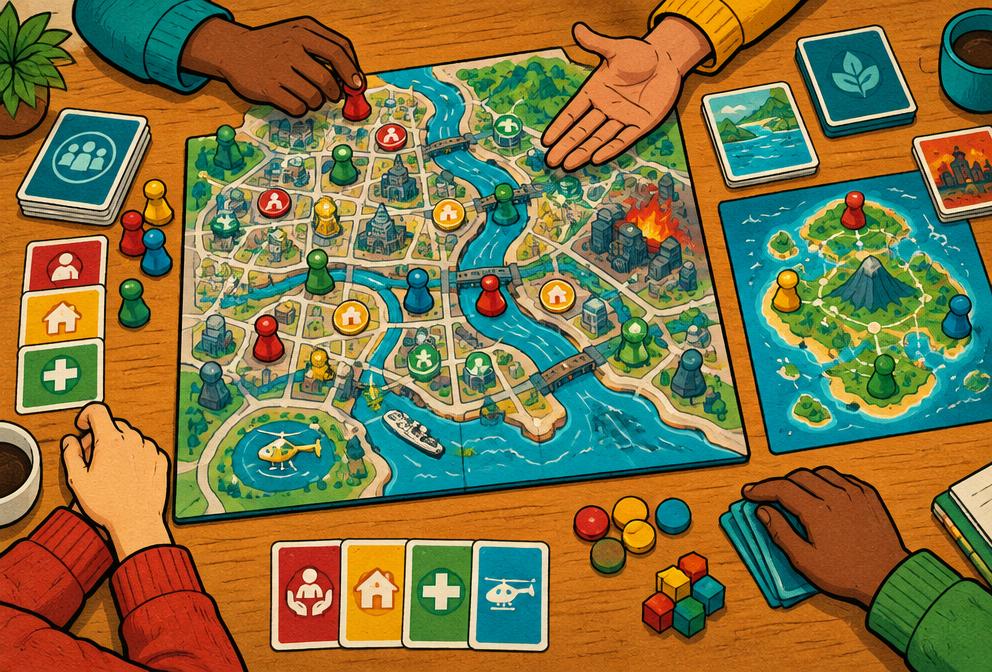
A cooperative game gives the table a common objective, but that does not automatically make it simpler than competition. Players still need to understand available actions, risk and losing conditions. Pick a first box whose explanation and listed session fit the people attending rather than choosing the most elaborate theme.
The examples here are deliberately related but distinct. Both come from Gamewright and use shared adventure objectives. Comparing them lets you decide between a shorter rescue and a broader survival problem without pretending that a list of ten famous cooperative games is useful for every beginner group.
| Candidate | Players | Listed time | Main shared problem |
|---|---|---|---|
| Forbidden Island | 2–4 | 30 minutes | Collect treasures and escape |
| Forbidden Desert | 2–5 | 45 minutes | Find a machine while managing survival |
Island: make the goal concrete
Forbidden Island’s team seeks four treasures before escaping a sinking island. That concrete destination makes it a reasonable first rulebook to investigate when your group wants a shared adventure without a long advertised session. The publisher lists ages ten and up, so inspect reading and rules demands before assuming it fits younger children.
Teach how the group wins and loses before describing every action exception. Players can then understand why a suggested move matters. Leave time for a practice turn and questions; a short listed playtime is not a timer you should use to rush a new participant.
Find your next table favorite
Good company. The right game. A night worth repeating.
Find a gameDesert: choose the added pressures intentionally
Forbidden Desert adds an ever-shifting board, sand and individual resource management to the search for a flying machine. Gamewright describes it as preserving familiar cooperative elements while offering a different experience. Those extra systems may be exactly what a curious group wants, but they are not automatically helpful for a reluctant first-time player.
Its two-to-five-player range can also settle a practical need that Island does not meet. If five people attend regularly, an unused fourth-seat game is not a better bargain because its listed duration is shorter. Choose the full product that accommodates the people you plan to include.
Prevent one person from playing for everyone
Open discussion is valuable when players exchange options, ask questions and explain their reasoning. It becomes less welcoming when a confident teacher dictates all moves. Establish that the active player chooses, and offer advice as a possibility rather than a command. This is a table agreement, not a special rule supplied by these games.
After a first session, ask whether people enjoyed discussing a common challenge and whether the pressure felt exciting or tiring. Use that feedback to guide the next purchase. Before buying now, check the base-game title, condition, language and delivered total; shared victory does not require buying both boxes.
Compare the games
As an Amazon Associate, Meeple Matters earns from qualifying purchases. These links open retailer searches; confirm the exact base game, edition, seller and delivered price.
Forbidden Island
A shorter treasure-rescue candidate for a first shared challenge.
Forbidden Desert
An alternative when five players or more survival planning matter.
Frequently asked questions
Are cooperative games automatically easier for beginners?
No. A shared goal changes who wins, but rule complexity and the game’s pressure still vary.
Which candidate fits five players?
Forbidden Desert lists up to five; Forbidden Island lists up to four.
How do we stop one player taking over?
Agree that the active player makes the final choice. Invite options and questions instead of issuing commands.
Sources & further reading
Source notes identify the facts each reference supports. Buying frameworks, schedules and price examples are editorial guidance, not research findings or current offers.
- Gamewright: Forbidden Island
Publisher specifications and shared treasure-rescue objective.
- Gamewright: Forbidden Desert
Publisher specifications, sandstorm, water management and standalone sequel description.
About this guide
Published by Meeple Matters, a board game discovery site. These AI-assisted guides synthesize publisher specifications, community scoring documentation and practical buying considerations. They are not hands-on reviews, original research or claims of professional testing. No individual reviewer credentials are implied.
Our current discovery catalog is limited, and store prices and Amazon ratings are estimates until verified data sources are connected. Check current specifications, stock and prices with the publisher and retailer. As an Amazon Associate, Meeple Matters earns from qualifying purchases through its shopping links.
Find your next table favorite
Good company. The right game. A night worth repeating.
Find a game